

Head of Production Management
There is currently a big debate about technologies employed when using Keyboard Video Mouse (KVM) systems to connect expert users in control rooms or engineering centers with remote, back-racked server- or PC-targets. At its core, it appears to be a technology discussion. Traditionally, KVM systems employed a dedicated network for the connection of users and targets and used a proprietary communication protocol, optimized for the various applications and needs of customers to control and manage the KVM system as well as the target applications and systems.
More recently, systems using the Internet Protocol (IP) as the transport mechanism carrying KVM payload information are promising lower cost of purchase through “Commercially Off The Shelve” (COTS) available equipment providing larger economies of scale and lower “cost per transported bit” at the time of purchase. When acquiring systems with an expected lifetime of over seven or ten years, a proper commercial evaluation has to take into account capital (CAPEX) and operational (OPEX) expenditures. As such, it is much less a technology and much more a commercial, in some case a philosophical discussion.
This discussion is fueled by a number of key hypothesis to take into account when planning and selecting a KVM solution.
Addressing Hypothesis 1
KVM system performance is often evaluated on the basis of these points:
As usual, the devil is in the detail. That said, small differences can have a huge impact. Lets look at scalability for instance. In a dedicated system like the IHSE Draco switch, each switch is designed to host a maximum number of inputs and outputs. Going one above the maximum requires a new chassis. In an IP based system, this can become a challenge to understand as various inputs can share switching capacity. System performance becomes a question of number of inputs and current load on each input. This can lead to congestion, in which case the switch manufacturer´s packet drop/congestion algorithm kicks in. To avoid this situation, each input and traffic type must be assessed carefully upfront and the maximum load needs to be factored in. If you want to avoid spending that safety margin in the bandwidth, connectivity becomes a function of traffic parameters and statistics.
Congestion scenarios and subsequent switch or router behavior have to be evaluated and agreed prior to system implementation. This is critical as switch congestion amounting to buffer overflows lead to dropped packets. In order to maintain overall operation by the switch infrastructure understanding the employed congestion management, the impact on various traffic types and the statistical expectations for overload situations occurring drive the IP switching system configuration and throughput design.
This IP based concept also makes scalability predictions much harder. Yes, theoretically, IP based systems are infinitely scalable. In reality, varying network load and additional endpoints/target devices may overload parts of the IP switch structure and appropriate scaling may require a much larger network re-shuffle than one would expect based on the additional load applied. Such matters are further complicated when sharing the IP network with other applications than the KVM system. At that point, non-mission critical traffic may drive switching congestion and hopefully the switch parameters have been set accordingly.
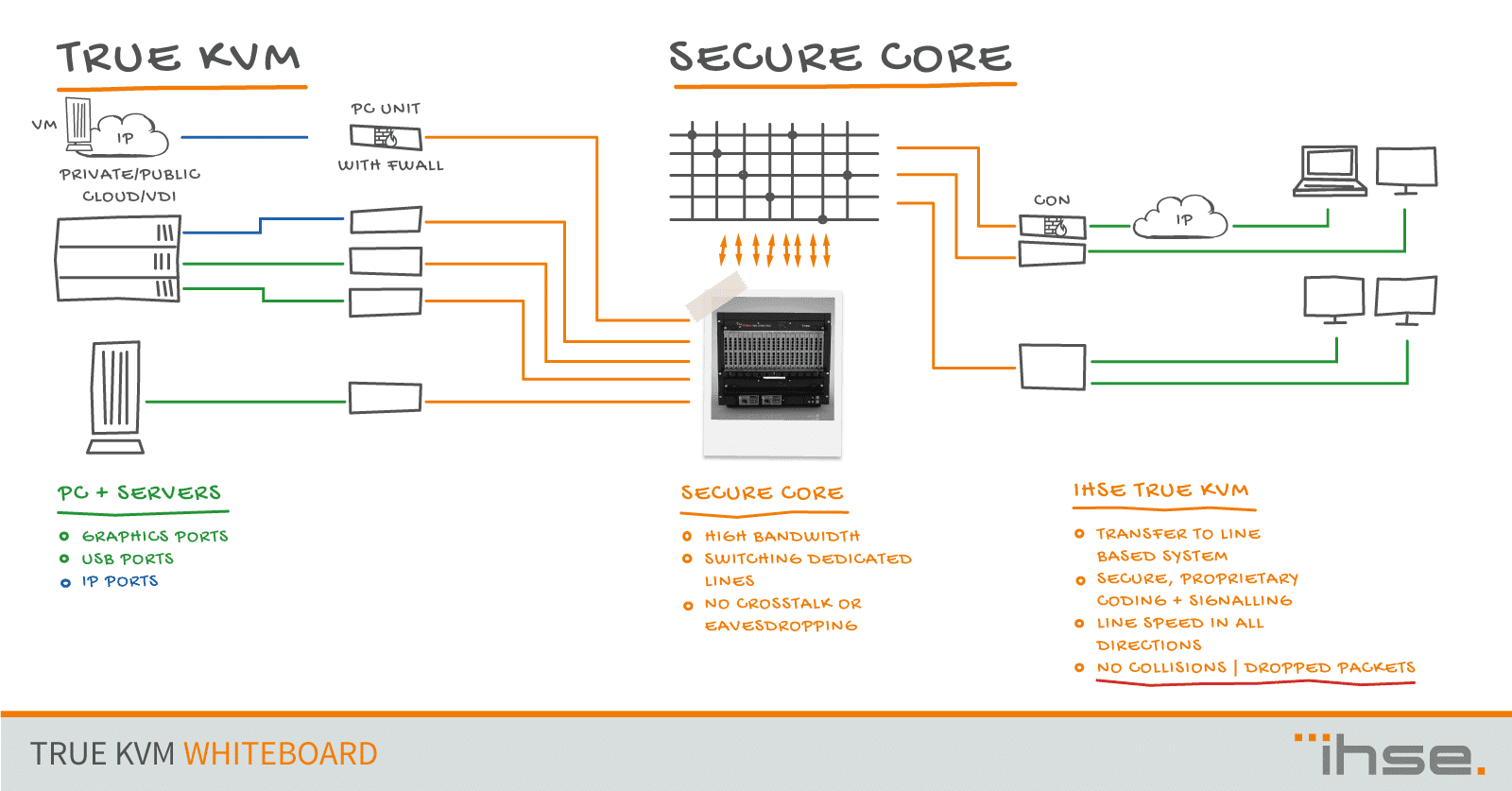
Direct Connect Summary, SECURE CORE
+ Truly out of band with data signal and control signal separation
+ Immune against Cyber Attacks as per design
+ One hand supply & service of complete infrastructure
+ Signal interface and protocol variability
– Proprietary transport protocol
– Proprietary switches
– More difficult CAN/WAN access options
– Requires dedicated transmission lines/bandwidth due to garanteed bandwidth
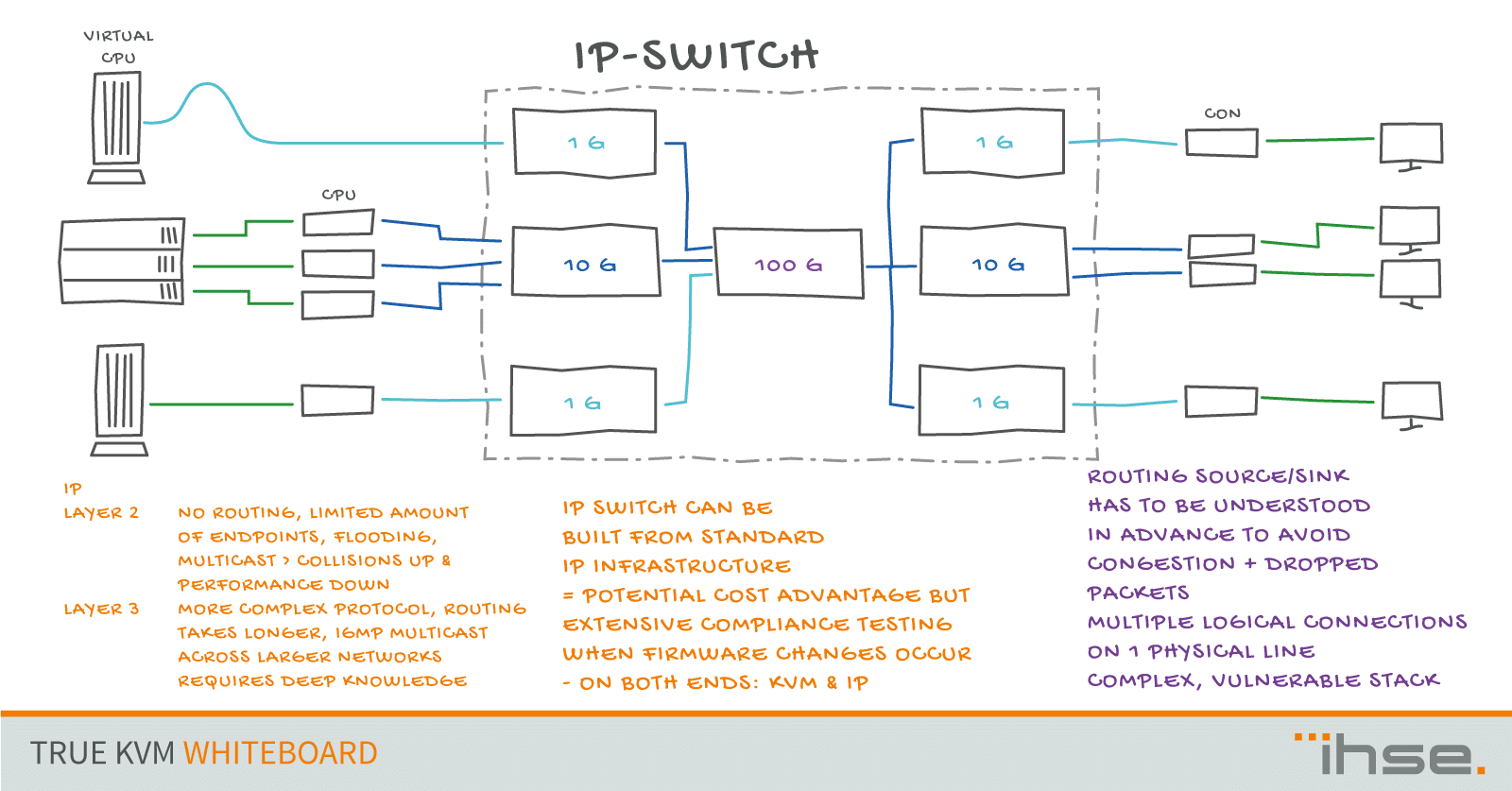
Once the number of endpoints exceeds a blocking free switching of the IP switch, the structure becomes more challenging. Essentially, based on the expected traffic volume by connected application, the architecture of the overall IP-Switch has to address the needs by employing a variety of switches connected to each other. This is a particular challenge for larger systems.
IP based Summary
+ Standardized transport layer protocol and components
+ TCP/IP provides multiplexing architecture to efficiently use bandwidth => 1G-10G-40G-100G
+ Easier CAN/WAN access options
+ Individual Stream-Routing-Flexibility
– Truly out of band only, when running on a separate network infrastructure – no VLAN
– Dependency on properly configured (homogeneous) network infrastructure
– Vulnerability to Cyber Attacks is eminent as there is no separation of management signal and data signal – systems can be jammed making them inoperable without even considering leaking data
– Dependency of proper interplay of KVM and IP infrastructure as there is no standard defined (Configuration, Firmware Updates, Default Parameters)
Whether you prefer an IP based solution or a Direct Connect solution is not only a philosophical discussion. Deploying a KVM system is a significant investment. Understanding the implications of each solution with respect to capex and opex is key and we will discuss this in the next part.
If you would like to discuss TRUE KVM with me in more detail, please leave a comment, send me a message or contact our technical support or sales teams at an IHSE office near you. We are here to help you get the most out of your KVM system.
Yours
Mark Hempel